Home › Study in UK › The money file
Path Plaza · UK programme · Pillar guide
How much money do you need to show for a UK student visa, and for how long?
Checked on 26 September 2026 · Path Plaza desk · re-checked every 30 days
You must hold the full amount for 28 consecutive days without the balance dropping below the required figure even once, and the closing statement must be dated within 31 days of the date you submit the application — not your biometrics date. The amount is living costs for up to nine months plus whatever tuition is still unpaid on your CAS. Rates changed in November 2025; check the current figures before counting.
01 · The rule that refuses more files than money does
What exactly is the 28-day rule and why do so many files fail on it?
It is not about how much money the family has. It is about an unbroken 28-day window ending close to the application date. One dip below the threshold, on one day, resets the clock.
Ask Pakistani families what sinks UK student visa files and most will say "not enough money". The threads say something more specific, and more useful: financial evidence is the leading cause of UK refusals, and the failure is almost always a counting error rather than a shortage. The requirement is that the full amount is held for 28 consecutive days without the balance dropping below the threshold even once — not once — with the closing statement dated within 31 days of the date the application is submitted.
Read that the way a caseworker reads it. The test is not "the family has money"; the test is "the money sat still, above a line, for a defined window, and the paper proves it". A family with lakhs to spare can fail it in a single afternoon — one transfer out that dipped the balance below the line for one day, and the clock resets to zero. A family with exactly enough, parked early and left untouched, passes it without drama. The rule rewards stillness, and stillness is free.
The distinction that catches even careful applicants, reported by a student who was refused on exactly this: the period runs to the application date, not the biometrics date. Many applicants plan their 28 days around the biometrics appointment, discover the submission happens earlier — or later — than they counted, and present a statement whose window no longer lines up. Count from the day you will actually press submit, and leave a margin on both ends: start the window a little early, and let the closing statement fall comfortably inside the 31-day freshness limit.
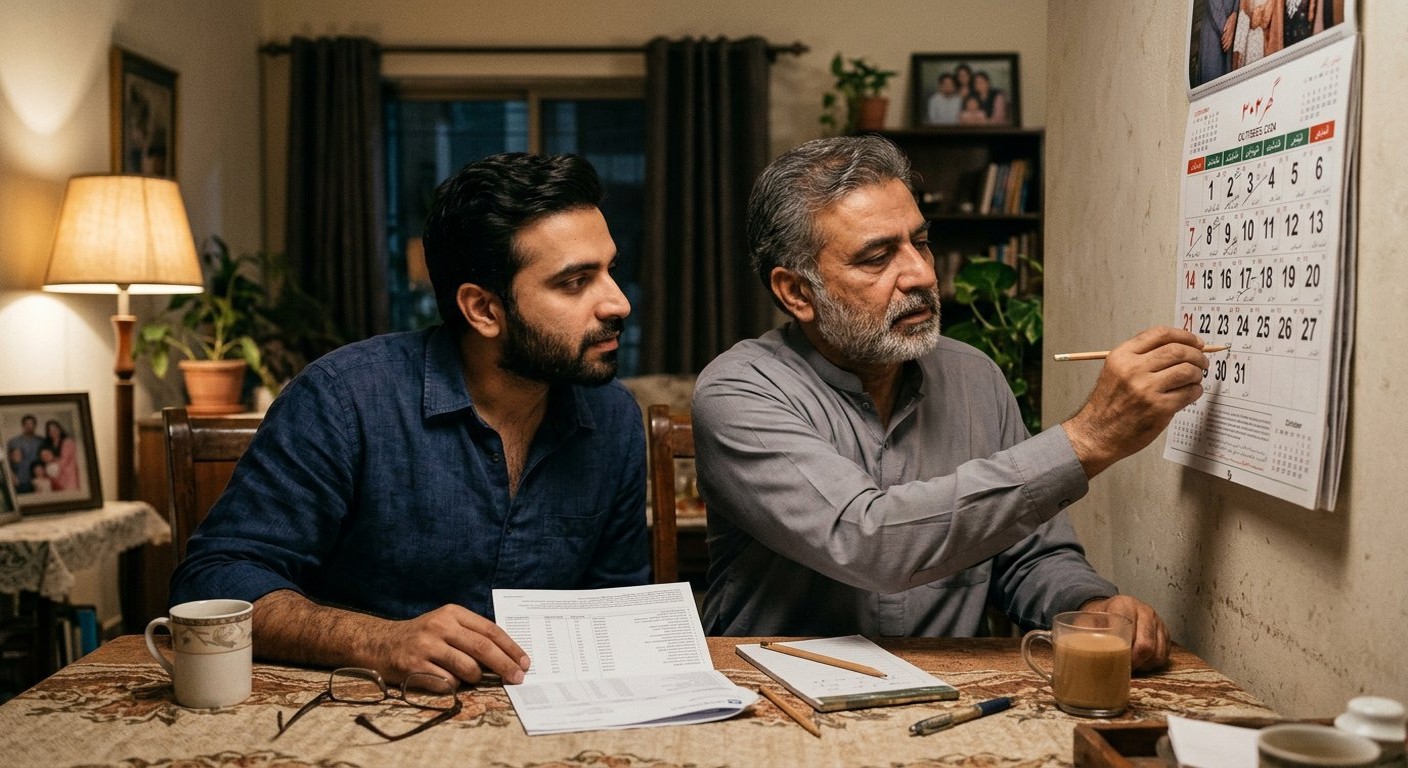
Hence the habit this desk teaches every UK family: mark the intended application date first, then count backwards on a calendar the whole family can see, then freeze the account for the whole window — no withdrawals, no transfers in that are not already documented, no "just this one payment". The 28-day counter on one page, the free sheet at the bottom of this page, exists because the counting is genuinely hard to hold in your head and genuinely easy to hold on paper.
02 · The figure itself
How much money do I actually need to show?
Living costs plus whatever tuition is still unpaid on your CAS. Pay some tuition in advance and the amount you must hold drops by the same figure. Check the current rates before you count anything, because these are revised.
The maintenance figures were revised with effect from 11 November 2025, and the current bands are stated as £1,529 a month for London and £1,171 a month outside London, counted for up to nine months — which gives the working totals of £13,761 and £10,539. That is the living-costs figure alone, and it is separate from tuition: whatever tuition is still unpaid on your CAS is added on top before the 28-day counting even begins. A one-year masters outside London with £5,000 of tuition still unpaid asks the family to hold roughly £15,500 still and provable; the same course with tuition fully paid in advance asks for roughly £10,500.
That last sentence is the most useful lever on this page, and families who understand it early save themselves real difficulty: pay some tuition in advance and the amount you must hold drops by the same figure. Tuition paid before the application is tuition the caseworker does not need to see in your bank account. For a family whose cash sits partly in business stock or property, paying the university early converts an unverifiable asset into a smaller, reachable requirement — often the difference between a comfortable file and an impossible one.
| Item | Figure | Notes |
|---|---|---|
| Living costs — London | £1,529 a month | Up to nine months: £13,761 total |
| Living costs — outside London | £1,171 a month | Up to nine months: £10,539 total |
| Dependants (each) | £845 London / £680 outside | Per month, per dependant — see the cost pillar |
| Unpaid tuition | As stated on the CAS | Added on top of living costs |
| Tuition already paid | Deducted | Reduces what you must hold, pound for pound |
One honest caution closes the section: these rates are revised, and a page on the internet — including this one — is a photograph of a moving thing. The figures above carry their effective date and this page's checked date; before any family counts actual money against them, the current official guidance should be read, and the desk re-verifies them inside every UK file it prepares.
03 · The account that holds it
Whose account can the money sit in?
Your account or a parent's, with a consent letter and proof of relationship. An uncle, a family friend or a company account will not do, however genuine the money is.
The guidance is precise about whose money counts, and the precision is the point. The account may be the applicant's own or a parent's — and a parent's account requires two supporting documents: a consent letter confirming the parent supports this use of the funds, and evidence of the relationship, such as a birth certificate. The two documents travel with the statement; a parental account without them is a parental account the caseworker cannot count.
What the guidance accepts as holdings is equally specific: current accounts, savings, and accessible fixed deposits. What it explicitly does not accept: shares, bonds, pension funds, and business accounts. This is where Pakistani family finances meet the rule most painfully — a family can be genuinely wealthy in property, in a running business, in a share portfolio, and still have nothing the Home Office can count. The money must be liquid, in an accepted instrument, in an accepted name, for the full window.
And the names that will not do, said plainly because agents quietly promise otherwise: an uncle, a family friend, a company account — none of them count, however genuine the money is and however willing the owner. A brother's or sister's account is not a parent's account. Where the family's real money sits in the wrong name, the move is early and legal: transfer into the applicant's or a parent's accepted account in time for the full 28 days, with the paper trail of where it came from attached, and with time to season. The transfer itself is not the problem — the problem is a transfer the file cannot explain.

Stillness is free
The rule does not ask the family for more money — it asks the money to sit still, above the line, for a window the family can mark on a calendar.
The 28-day counter is free on WhatsApp — below.
04 · When the bank is the problem
My bank could not be contacted and my statement was rejected. What now?
Choose the bank for how reachable it is, not only for where the money already sits. A statement the Home Office cannot verify counts for nothing.
This is the refusal that angers families most, because it is not the applicant's fault in any ordinary sense. A refusal notice quoted in full on the forums explains the mechanics: the Home Office must verify a financial document against central records rather than through an individual branch, and when it cannot contact the institution, the document cannot be counted towards the financial requirement. The money was real; the statement was genuine; the bank simply did not answer — and the file fell anyway. Others on the same forum report bank verification problems again and again, which is what makes this a planning question rather than bad luck.
The recovery route, from the same threads: move the funds to a bank known to respond to verification requests, wait a fresh 28-day window with the money sitting still in the new account, and include a cover letter giving the bank's contact details and the signing manager's details, so the caseworker's verification path is short and obvious. It costs the family a month. It is maddening. It is also entirely avoidable, if the bank is chosen for reachability at the start rather than discovered for silence at the end.
So the desk's rule for UK files: choose the bank for how reachable it is, not only for where the money already sits. Large Pakistani banks with central verification desks and a record of responding to Home Office checks are worth moving money for; a statement the Home Office cannot verify counts for nothing, whatever the balance printed on it. This is also why the file carries the manager's name and direct contacts on the cover letter — the verification is the caseworker's work, but a file that makes the work easy is a file that moves.
05 · The payment the rule does not forbid
Does paying the health surcharge out of the same account break the 28 days?
The test is whether the balance ever fell below the required figure. Keep a margin above the threshold so ordinary payments cannot take you under it.
This question was asked directly by a refused applicant who noticed the trap late: the immigration health surcharge is due at application, families often pay it from the same account that carries the maintenance money — and the applicant, whose balance still exceeded the requirement afterwards, wanted to know whether the withdrawal itself broke the window. The question deserves its answer stated as a rule, because the rule generalises to every payment a family might make during the window.
The underlying test is the floor, not the withdrawal. What matters is whether the balance ever fell below the required level at any point in the window — the rule is silent on payments as such. A health surcharge paid from a balance comfortably above the threshold changes nothing; the same payment from a balance hovering at the line takes the file under it and resets the clock. The surcharge is also not small, and it is due precisely in the weeks families are watching the account most anxiously, which is why it catches people who understood the rule perfectly.
The working instruction follows from the rule: keep a margin above the threshold so ordinary payments cannot take you under it. The desk plans UK files with a buffer above the required figure — enough to absorb the surcharge, a utility bill, a family emergency — because a window at the line is a window one bill away from restarting. If a payment must be large, it goes from a different account. The maintenance account does one thing for 28 consecutive days: it sits still, above the line, provably.
06 · Borrowed money, counted properly
Can I use a bank loan as proof of funds?
A loan can work, but it has to be in the account and seasoned like any other money. A sanction letter on its own is not proof of funds.
Loans are the quiet route many Pakistani families actually use, and the threads treat them matter-of-factly rather than suspiciously. A student who went through the process reports that loans appear to draw a quicker response than personal savings — plausibly because a disbursed loan from a known bank is itself a verified, documented instrument — and advises using established banks rather than non-bank finance companies, which are described as less favourably viewed. The distinction is practical, not moral: the caseworker needs to verify where money came from, and an established bank answers that question in one document.
The key point, and the one families get wrong: a sanction letter alone is not enough. The approved amount must actually be disbursed into the account and held for the full 28 days, with evidence of where it came from. A letter promising ₹25 lakhs is a promise; money in the account above the line for the window is proof. The loan therefore has to be timed like everything else in this file — disbursed early enough that the 28 days can complete before the application date, not applied-for early enough.
Put beside the rest of this page, the loan route is simply another way of filling the same container: the right amount, in an accepted account, in an accepted name, sitting still for the window, with the source documented. Families who treat the loan as "different money with easier rules" are the ones who file a sanction letter on its own and learn the difference the hard way. The desk's loan files are built to the same standard as its savings files, and the standard is the one this whole page keeps repeating — and it is written on the free counter sheet below.
Coming with the UK video series
The 28-day rule — on video, in Urdu
The window, the floor and the reset, walked through on a real calendar the way the desk walks it with families — in Urdu. In production; this page is the written reference until it ships.
Free one-pager · WhatsApp · no forms
Get the 28-day counter on WhatsApp
A calendar grid the family fills in themselves, working back from the intended application date — with the floor, the margin and the reset marked.
Get the 28-day counter → +92 315 5009620 · Mon–Fri 11AM–7PM · Path Plaza (SMC) Pvt Ltd, 304 Upper Mall, LahoreWhere this sits in your journey
The money file is built before the application exists — it is the one part of a UK file that cannot be assembled quickly.
Universities decide admissions. The UK authorities decide visas. We prepare honest, complete files — that is the entire promise, and it's in writing.