Home › Study in Ireland › Ireland or the UK
Path Plaza · Ireland programme · Pillar guide
Ireland or the UK: which suits a Pakistani student better?
Checked on 26 September 2026 · Path Plaza desk · re-checked every 30 days
Ireland's route after graduation is clearer than the UK's — up to 24 months of unsponsored work, then a defined permit ladder towards residence — and its fees are broadly comparable. Its housing market is the hardest of this desk's four destinations, and the sponsorship market is unforgiving in fields off the critical skills list. Both halves belong in the decision, and both are on this page.
01 · What Ireland actually offers after the degree
What is the route from student to long-term residence?
Ireland does have a defined route to long-term residence, which is genuinely one of its strengths. The whole plan turns on securing an employment permit before Stamp 1G runs out.
Say plainly what many destinations leave vague: Ireland does have a defined route from student to long-term residence, and it can be written on one page — which is more than can be said for most countries in this price bracket. The sequence runs Stamp 2 for the duration of the programme, then Stamp 1G for 12 or 24 months to find work, then an employment permit — a Critical Skills Employment Permit for occupations on the critical skills list, or a General Employment Permit otherwise — then Stamp 4 with unrestricted work rights, commonly described as reachable after two years on a critical skills permit.
Read it as a relay, not a staircase. Each stage buys time for the next, and no stage guarantees the one after it: the university does not guarantee the 1G application, the 1G does not guarantee a permit, and the permit stage is the one where the graduate, not the system, carries the baton. The whole plan turns on securing an employment permit before Stamp 1G runs out — the window is generous by the standards of graduate permissions, and it is still a window.
Two honest notes on the shape of the route. First, it favours the prepared: the graduates who use 1G well arrive with a course that points at the critical skills list, a CV built across the study years, and applications going out in the first months of the window, not the last. Second, it is a route to residence, not to citizenship on rails — the naturalisation question carries its own reckonable-residence rules, covered on the 1G pillar, and families should read that section before treating the eighth year as automatic. What the route genuinely offers is what the marketing says it offers: a country where the path from degree to lasting status is written down, published, and followed by real people every year.
It is worth being equally clear about what the route does not do, because families sometimes hear "defined route" as "defined outcome". The route does not shorten the line for a permit; it does not oblige any employer to hire a fresh graduate; and it does not convert a part-time job in a café into an employment permit case. What it does is remove the ambiguity that kills plans in other destinations — the graduate always knows which permission they are on, what it allows, what comes next, and by when. In the desk's experience that clarity is worth more than it sounds: plans fail more often on vagueness than on difficulty.
02 · The hard half of the honest answer
Will I actually find a sponsored job in Ireland?
Check the critical skills occupations list before choosing the course, not after graduating. If your intended field is not on it, the route is materially harder and you should know that at the outset.
This section quotes the critical view at full strength, because it is the half of the comparison that brochures omit. One Irish commenter describes the pattern they have watched: students spend roughly €25,000 on a masters and €15,000 on living, work in fast food for two years, and return home because nobody will sponsor them — in debt and resentful. Another states flatly that no company will sponsor after the masters. A third notes that transitioning a student visa into residency is difficult without an employer willing to sponsor. These are individual voices, not statistics; but they are Irish voices, describing their own labour market from inside it, and a family in Lahore should hear them before it hears a salesman.
Set against this, the formal route exists and the critical skills list is real. Both things are true at once, and the difference between the graduates in the two accounts is the difference this desk exists to make: the list. Occupations on the critical skills list carry the permit the route needs; occupations off it depend on a General Employment Permit and an employer willing to argue a labour-market case for a fresh graduate — a materially harder sale. The course chosen in Lahore decides which side of that line the graduate stands on two years later in Dublin.
Hence the instruction that titles this section: check the critical skills occupations list before choosing the course, not after graduating. If your intended field is not on it, the route is materially harder and you should know that at the outset — it may change the course, the destination, or both. Where the field is on the list, the honest reading is not "guaranteed" but "the door is real" — and the families who do best are the ones who treat the two study years as the first two years of a job search, because in every meaningful sense they are.
A note on the two-year pattern in the critical account, because it hides a mechanic worth understanding: the graduates described were working in fast food for two years — that is, on Stamp 1G's full-time permission, in roles that lead nowhere near a permit. The 1G window is generous enough to survive a wrong first job and still leave time for a right one; it is not generous enough to survive two years of drift. The graduates who convert the window are the ones who treat the first six months of it as the most deliberate job search of their lives, planned week by week, aimed at employers who actually sponsor — while the ones who describe Ireland as a trap are describing a window spent on the easiest available shifts. Same permission, two very different sentences at the end of it.
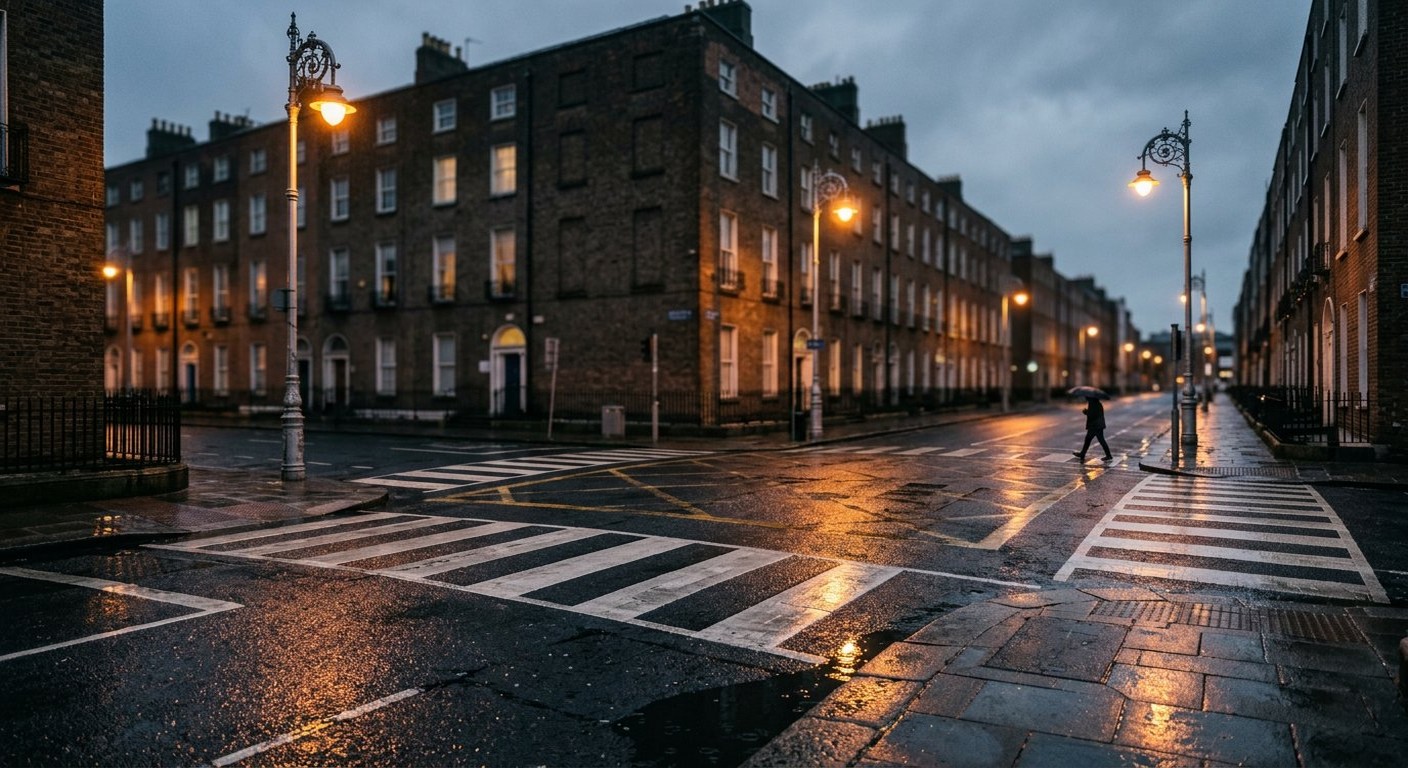
Two directions, one decision
Fees broadly comparable — the difference is what follows the degree, and what it costs to live there while you earn it.
The student to Stamp 4 route is free on WhatsApp — below.
03 · The comparison, in a family's terms
How does Ireland compare with the UK for a Pakistani student?
Ireland's post-study permission is generous and its route to residence is clearer. Its housing market is the hardest of the four destinations. That is the real trade-off and it should be put to families in exactly those terms.
The most useful comparison in the whole Ireland bank comes from a Pakistani contributor who studied in the UK — a masters in 2017 — and later lived in Ireland. Their account sets it out directly: good universities, with fees broadly comparable to the UK's; and a post-study work permission that, they note pointedly, they did not have when they did their UK masters. The permission is the difference that travels: an Irish graduate today gets up to 24 months of unsponsored work rights, and that window shapes the entire after-degree story in ways a 2017 UK graduate never had.
The same contributor observes that Ireland is simply not on the radar for Pakistani students — and says they do not know why. That observation is the quiet finding under this whole programme: an English-speaking, EU-adjacent destination with a defined residence route and almost no honest Urdu content explaining it to the families who could use it. Low awareness is not a warning here; it is an opening, and it is why this desk treats Ireland as a serious option rather than a footnote — a destination where a prepared Pakistani family arrives with less competition for attention, for accommodation advice and for honest answers than in any city the family already knows by name.
And the counterweight — which the same contributor gives repeatedly and emphatically — is housing. This is where the comparison with the UK stops being abstract: Ireland's rental market is the hardest of this desk's four destinations, and the accommodation pillar shows the bands that make it so. So the honest summary, in exactly the terms the playbook orders it put to families:
| What Ireland gives | What it costs you |
|---|---|
| Post-study permission of up to 24 months, unsponsored, any employer | The hardest housing market of the four destinations — budget from the room upwards |
| A defined route through employment permits towards long-term residence | Sponsorship is unforgiving in fields off the critical skills list — choose the course against the list |
| Good universities, English-medium, with fees broadly comparable to the UK's | Off the family radar — less community knowledge, and almost no honest Urdu content to consult |
That table is the comparison, and it is deliberately short. A funded family whose course points at the critical skills list and whose budget carries the top of the rent bands is looking at the stronger post-degree position. A family stretching the budget on the strength of part-time earnings is looking at the harder year — in either country. For the families who ask the follow-up question — "so which one should we choose?" — the desk's answer is that the question is not answerable in the abstract, and any consultancy that answers it without seeing the family's budget, the student's field and the course in question is guessing with your money. The verdict page puts the whole picture together; the comparison stops here, in exactly those terms.
Coming with the Ireland video series
Ireland or the UK — on video, in Urdu
The route, the list and the rent, compared the way families compare them across the desk — in Urdu. In production; this page is the written reference until it ships.
Free one-pager · WhatsApp · no forms
Get the student to Stamp 4 route on WhatsApp
The relay on one page — Stamp 2, Stamp 1G, the permit, Stamp 4 — with the narrow point marked where the job must be secured.
Get the student to Stamp 4 route → +92 315 5009620 · Mon–Fri 11AM–7PM · Path Plaza (SMC) Pvt Ltd, 304 Upper Mall, LahoreWhere this sits in your journey
The comparison page is where families usually arrive first — and it is the right place to start, provided both columns of the table are read.
Universities decide admissions. The Irish authorities decide visas. We prepare honest, complete files — that is the entire promise, and it's in writing.