Home › Study in Ireland › Accommodation and cost
Path Plaza · Ireland programme · Pillar guide
What does a year in Ireland cost, and how bad is the accommodation situation?
Checked on 26 September 2026 · Path Plaza desk · re-checked every 30 days
Treat accommodation as the first decision, not the last: Ireland's rental market is the hardest of this desk's four destinations, with shared rooms in Dublin at €600–800 and one-bedrooms from €1,400, and students who arrive without somewhere to stay sometimes leave months into the course. Secure something before you travel — even at a worse price — and budget as though you will pay near the top of the range.
01 · The crisis, in plain words
How bad is the accommodation situation really?
Treat accommodation as the first decision, not the last. Secure something before you travel even if it costs more than the ideal, and budget as though you will pay near the top of the range.
Start with who is saying it. The accommodation crisis in Ireland is raised constantly — and mostly by Irish people themselves, not by agents talking down a competitor. A subreddit's own automatic notice warns that it is a bad time to move to the country because of a severe accommodation shortage. When the hosts say the market is broken, a family in Lahore planning around glossy student-city photographs should listen.
The figures people give are consistent. A room in a shared flat runs at €600 to €800, rising towards €900 to €1,000 and higher the closer you get to the city centre. One-bedroom apartments in Dublin start at around €1,400 to €1,500 — minimum. The table below is the honest version of what the accommodation websites show you after the filters are cleared.
| What you are renting | Monthly band | The honest note |
|---|---|---|
| A bed in a shared room | €400–600 | The compromise students make to afford anything at all |
| A room in a shared flat | €600–800 | The realistic base case for a student in Dublin |
| A room near the centre | €900–1,000+ | Location is the premium; the same room costs less further out |
| A one-bedroom apartment | €1,400–1,500+ | Not a student option in Dublin unless the budget is exceptional |
| Purpose-built student accommodation | varies, often high | Secure but priced at the top of the market — check what is included |
What the bands do not show is the scarcity. One long account describes finding a place as nearly impossible on a student budget, with students sharing rooms to afford anything at all. Another describes students unable to find accommodation at all — staying in short-term lets at tourist prices while searching, and some leaving months into the course because the arithmetic never worked. These are individual accounts, not statistics; but they recur, they agree, and they come from the country's own residents.
The desk's rule falls out of all of this: treat accommodation as the first decision of the Ireland plan, not the last. Secure something before you travel, even if it costs more than the ideal, and budget as though you will pay near the top of the range — because the family that plans for €600 and finds €850 has a problem, while the family that planned for €1,000 and found €800 has a margin. Where the budget cannot carry the top of the range, the honest conversation is a different city — Cork, Galway, Limerick carry meaningfully lower rents than Dublin — or a different destination entirely. It is worth naming the mechanics of the hunt, because they differ from Pakistan in ways that surprise families: viewings are competitive and quick, documents move fast when a landlord says yes, and the demand-side pressure is created by the whole population of the city, not only students. The families who do well are the ones already in the country with references ready, which is precisely why the pre-departure secure-something rule exists — the search is easier to run from a short-term let in Dublin than from a bedroom in Lahore.
The city choice deserves one more sentence of honesty: Dublin is where the jobs, the head offices and the biggest student services are — but Cork, Galway and Limerick are real university cities with meaningfully lower rent bands, and the students there describe a calmer arrival and more money left at the end of the month. The trade is genuine and it belongs in the decision from the first conversation, not after the first viewing in Dublin.
02 · The visa question nobody expects
Do I need confirmed accommodation for the visa itself?
Because at least one refusal has cited it, supply what you can. Even a provisional booking or a university accommodation offer removes a possible objection at no cost.
Here the honest answer has to hold two facts that genuinely conflict, and say so. On one side: a real refusal letter lists R — no confirmation of accommodation booking for the duration of stay — among its reasons. The code exists, it is issued, and it has ended applications. On the other side: students in the same forums state that accommodation details are not required for the application, that most applicants have nothing arranged at the application stage, and at least one reports a successful outcome having sorted housing only after arrival. Both accounts are true; the requirement, in practice, is inconsistent.
What does a family do with an inconsistent requirement? The desk's answer is the same as it is everywhere in this programme: close the objection you can close, cheaply, before it is raised. A provisional booking, a university accommodation offer, even a documented place on a waitlist — any of these removes the R objection at essentially no cost, and costs you nothing if the officer never looks at it. Insurance you do not need is wasted; insurance that prevents a refusal is the cheapest line item in the file.
There is a second, quieter reason to have housing paperwork in the visa file: it answers questions the officer may not even code. An applicant with accommodation arranged reads as a plan; an applicant with none reads as an arrival that has not been thought through. The refusal pillar shows how those impressions harden into codes — and how the cheapest answers are the ones prepared in advance.
The sequencing the desk advises: apply for university accommodation the day the offer letter arrives — campus rooms are allocated first-come and vanish in exactly the way the private market does. If the university has nothing, book a refundable short-term let for the first fortnight and say so in the file. It is not the perfect plan; it is the plan that survives contact with Dublin in September. And before any private deposit leaves any account, the same rules that protect families in every rental market apply with extra force in a shortage: nothing is paid before a written agreement states what it is for, when it is refundable, and who is returning it; a receipt exists for every transfer; and a listing that demands speed and cash against no paperwork is describing itself plainly enough. In a market this tight, the fraud that feeds on urgency is part of the accommodation situation — treat it as such.
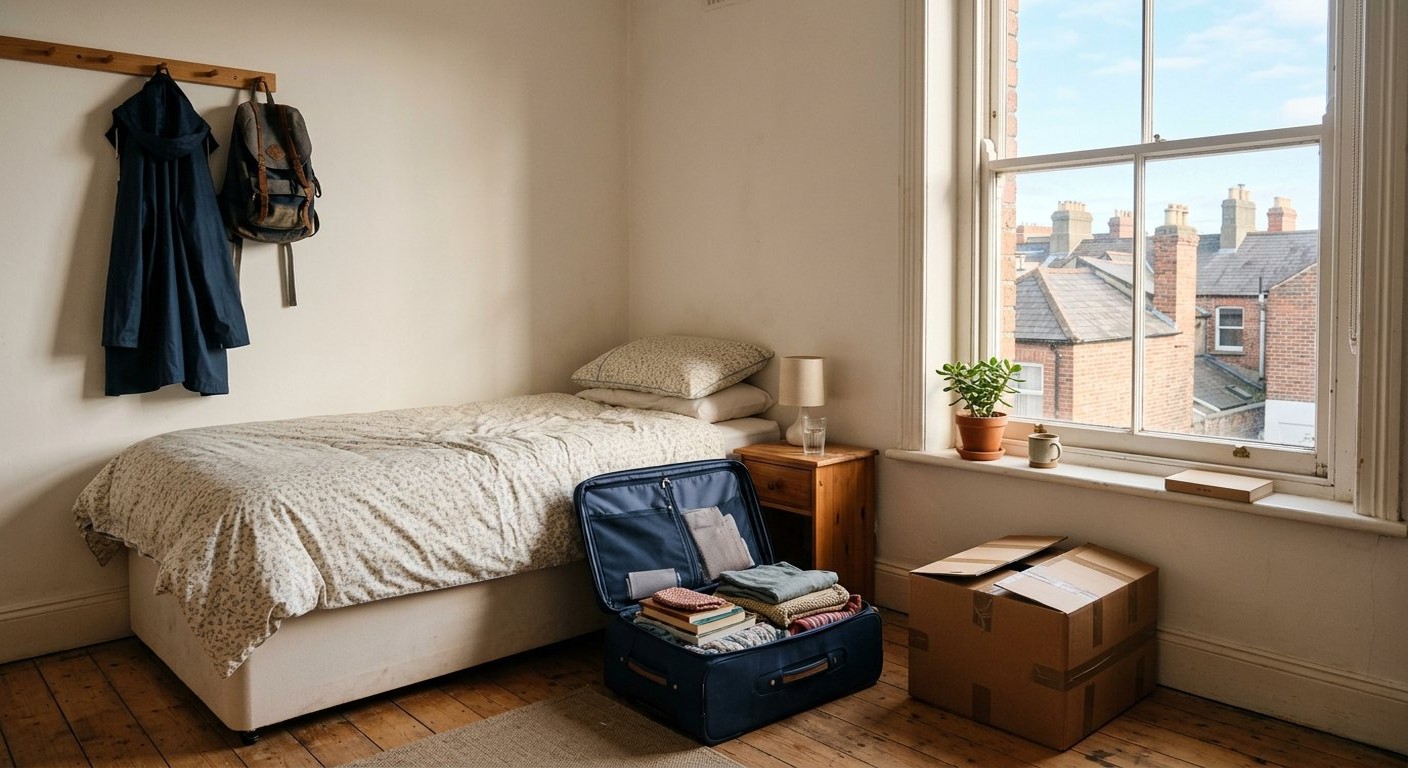
The room decides the budget
Plan for the top of the band and let the lower rent be a margin — never the reverse.
The accommodation plan and rent budget is free on WhatsApp — below.
03 · The whole year, in euros
What does a year in Dublin actually cost in total?
Build the budget from accommodation upwards, not from tuition downwards. In Ireland rent is the variable that decides whether the rest works.
A student weighing the decision put a one-year Dublin course at roughly €35,000 to €40,000 all in — tuition plus living. A commenter describes the common pattern as about €25,000 on a masters and €15,000 on living costs. Another puts the same point as a test: unless €2,000 a month of living is comfortable, the plan is difficult. Put the three together and a shape appears: the ranges agree with each other, and the monthly figure is doing most of the work.
Which is why the budget must be built from accommodation upwards, not from tuition downwards. Tuition is fixed, published, and identical wherever you sleep; rent is the variable, and in Ireland the variable is enormous. At €800 a month the year's housing is €9,600 before deposits, bills or the short-let weeks at arrival; at €1,000 it is €12,000 — a €2,400 difference that no amount of grocery discipline recovers. The family that budgets tuition first and "whatever rent turns out to be" second has built the plan backwards, and Dublin in September will correct it for them.
The honest all-in picture, assembled from the bands on this page and the money rules in the financial pillar: tuition as the institution states it (commonly around €25,000 for a one-year masters, varying by programme and institution); rent at the top of the realistic band, not the bottom; food, transport, a phone and the ordinary infrastructure of life on top; the visa stack and the residence card registration fee; flights; and the arrival fund — deposits and the first weeks before anything is settled. The €10,000 living-expenses figure the immigration guidance expects you to access is the floor for the official check, not the budget; the families who do the year comfortably are the ones who planned above it, and the students who struggle are the ones who treated it as the number. The difference between the two groups is not income; it is whether the budget was built around the room before the flights were booked, which is the entire argument of this page in one sentence.
One more honest line, because this page is the one place it belongs: the cost of Ireland is the cost of the room. Choose the city by the rent bands as much as by the course catalogue — a programme in Cork or Limerick with housing at €500 can cost less overall than a cheaper-listed Dublin programme with housing at €900, and the student in the smaller city is frequently the one with money left in March. The verdict on whether Ireland is worth it at all belongs to the final pillar — but the arithmetic that feeds that verdict is decided here.
Coming with the Ireland video series
The accommodation picture — on video, in Urdu
The rent bands, the September scramble and the arrival fund, walked through the way the desk walks families through it — in Urdu. In production; this page is the written reference until it ships.
Free one-pager · WhatsApp · no forms
Get the accommodation plan and rent budget on WhatsApp
Bands by city and room type, an emergency short-let fund line, and the questions to ask before paying any deposit.
Get the accommodation plan → +92 315 5009620 · Mon–Fri 11AM–7PM · Path Plaza (SMC) Pvt Ltd, 304 Upper Mall, LahoreWhere this sits in your journey
Accommodation is the first decision of the Ireland plan — the budget is built on it, and the year stands or falls on it.
Universities decide admissions. The Irish authorities decide visas. We prepare honest, complete files — that is the entire promise, and it's in writing.