Home › Study in Malaysia › Money and deposits
Path Plaza · Malaysia programme · Pillar guide
What does a month in Kuala Lumpur cost, and what are the deposits?
Checked on 25 September 2026 · Path Plaza desk · re-checked every 30 days
Students living there put non-rent living at roughly RM 800 to 1,500 a month, with rooms from about RM 300 to 800 — but the number that surprises families is the deposit: commonly two months' rent plus a further half month for utilities and extras, payable upfront before the first month even begins. Budget the deposit separately, and add a margin, because budgets here are routinely underestimated.
01 · The honest monthly picture
What does a month actually cost in Kuala Lumpur?
Ask for the all-in figure: tuition, rent, living, visa and medical charges, insurance, deposit and flights. Anyone quoting tuition alone is quoting half the answer.
Student answers are detailed and remarkably consistent once accommodation is separated out. Excluding rent, most put the figure around RM 800 to 1,500 a month: food RM 300 to 900 depending heavily on cooking, transport RM 60 to 300, phone and internet RM 40 to 100, utilities RM 40 to 150 when shared. Including rent, students describe living comfortably on around RM 2,000 and frugally on RM 1,200 to 1,500.
It helps to see the bands as levers rather than verdicts. The food band's width — RM 300 to 900 — is almost entirely the cooking question, and a student who learns three reliable home dishes in the first month moves permanently toward the bottom of it. The transport band collapses the moment the train pass replaces ride-hailing. Nothing here is poverty; all of it is selection, and the students who do it consciously report the same thing: the comfortable life and the careful life are closer together than the brochures suggest.
The one-liner the threads contribute is worth keeping: the city is not expensive, but the lifestyle is. Eating out daily, ride-hailing instead of the trains, a studio instead of a shared room — each choice alone is affordable, and together they are the difference between the comfortable figure and the frugal one. Several students warn that budgets are routinely underestimated and advise adding a margin; we advise the same, and the worksheet below builds one in.
| Item | Band (RM/month) | What moves it |
|---|---|---|
| Food | 300–900 | Cooking at home against eating out — the single biggest lever |
| Transport | 60–300 | Public transport against ride-hailing |
| Phone and internet | 40–100 | Plan and data habits |
| Utilities (shared) | 40–150 | Air-conditioning is the variable families underestimate |
| Room in a shared unit | 300–800 | Area, condition, distance from campus |
| Master room | 900–1,200 | Pricer student areas push the top of the band |
| Studio | 900–1,500+ | Freedom, at a price |
Those are bands reported by students, not promises — areas and intakes move them, and the honest plan uses the top of a band, not the bottom. Anyone quoting tuition alone is quoting half the answer: the all-in figure is tuition, rent, living, visa and medical charges, insurance, deposit and flights, together.
02 · The tightest honest budget
Can I manage on RM 1,000 a month?
Possible, but only sharing and cooking, and with no margin at all. Plan RM 1,500 and you have room to breathe.
There is a direct thread on exactly this figure, and the consensus is clear: RM 1,000 is possible only with a shared room, home cooking and public transport, and it is very tight — with no margin for a flight change, a medical bill or a lost deposit. Several contributors say it is not realistic at all if rent is included, particularly in the more expensive student areas.
It is also worth saying what RM 1,000 does not include, because the number travels without its luggage: no flights, no visa and medical charges, no insurance, no deposit, no books or one-off equipment, and no month in which anything goes wrong. The number is a floor for the best case, and families deserve to know they are reading a floor.
The practical advice the thread lands on is better than the number: start in a hostel, get to know senior students, and find shared accommodation through them rather than online. Senior students know which buildings are fair, which landlords return deposits, and which "great deal" listings are the fraud pattern described two sections down. That knowledge is worth more than any budget line.
And pair the number with the truth from the work-rules pillar: permitted work cannot plug this gap, because permitted work is holiday-period only and capped. A budget that only balances at RM 1,000 with imagined wages is not a budget — it is a delay before a phone call home. Plan RM 1,500 and you have room to breathe; that is the honest number.
03 · The arrival surprise
How much is accommodation and what are the deposits?
Budget the deposit separately and early. It is commonly two months' rent plus extras, and it is the single largest surprise cost on arrival.
The detail most often missed in every family budget is the deposit structure. It is commonly two months' rent as the deposit, plus a further half month for utilities, plus access card charges and tenancy stamping — and one student sets out the arithmetic plainly: a RM 2,000 unit requires about RM 5,000 upfront, plus the first month's rent. The money leaves the account before the boxes are unpacked.
Why this surprises families is structural: the deposit is not a monthly cost, so it never appears in the monthly budget — and it arrives in the same fortnight as the flight, the first month's rent, the medical, the insurance and the phone. The arrival month is simply not a normal month, which is why the worksheet below keeps two columns: the arrival fund and the monthly budget, never mixed.
When the deposit does come back, it comes back slowly — at the end of the tenancy, after inspection, against the stamped agreement and the check-in record. Which means the arrival fund is not an expense so much as a bridge: money that leaves the account for months and returns if the paperwork was right. Families who understand this plan the arrival month with a cushion; families who do not discover the cushion in the second month, by its absence.
The deposit is also the money most worth protecting, because it comes back only if the paperwork is right — a properly stamped agreement, a check-in condition record, and a landlord who returns it. Which is the subject of the next question.
04 · The fraud with your deposit
How do I avoid being cheated on accommodation?
Take university accommodation for the first semester. If renting privately, never transfer to a personal account and never pay before a properly stamped agreement.
Rental fraud is widely reported, and the pattern is consistent enough to recognise in one paragraph: a below-market listing, somebody impersonating a legitimate agent, a viewing conducted by an unaware assistant, then pressure to transfer immediately to a personal account. One account records the writer being the fourth victim in the same building, with several thousand ringgit lost between them. A separate warning concerns listings described as co-living space that turn out to be converted hotel rooms.
Every element of the pattern is a defence when inverted. A below-market price is a reason to check, not to grab. An agent's identity is verifiable against the agency. And money — always — goes to a company account against a properly stamped agreement, never to a personal account against a promise. No legitimate landlord loses a tenant to paperwork; every fraudster loses a victim to it.
The safest first semester is the one the threads recommend and we repeat: university accommodation, whatever its compromises, while you learn the city, the prices and the people. Then rent through senior students' knowledge, with every payment documented. The pass pillar covers what a documented life in Malaysia looks like; this page's version is simpler — no personal accounts, no unstamped agreements, no exceptions for urgency.
05 · The number the file shows
How much money must I show for the visa?
Confirm the figure with your own institution rather than relying on a general number, and build the balance over months rather than depositing it days before applying.
The guidance indicates an expectation of around RM 1,200 a month for living expenses — roughly RM 14,400 a year — and medical-course guidance for Pakistani applicants refers to bank statements showing around MYR 40,000 as a minimum for that route. Figures differ by institution and course, and should be confirmed rather than assumed: the number that governs is the one your own institution states in writing.
How the balance looks matters as much as what it is. A statement built over months reads like a family's real economy; a large deposit days before applying reads like exactly what it is, and reviewers are not new. This is the same discipline the EMGS pillar teaches about patience — the file is read, and the file remembers.
A note on the psychology, because it decides more than the arithmetic: the visa figure is the one number in this file that a family can prepare for years in advance, and the ones who do — who let a savings account age quietly alongside the student's schooling — arrive at the application with the least stressful document in the file. The bank statement is the only page of the application that takes years to write. Start it early.
So the money question closes where the whole pillar closes: the all-in figure, confirmed in writing with the institution, built over months, with a margin added because budgets are routinely underestimated. The worksheet below puts all of it on one page — two columns, deposits itemised, the arrival fund kept separate from the monthly budget.
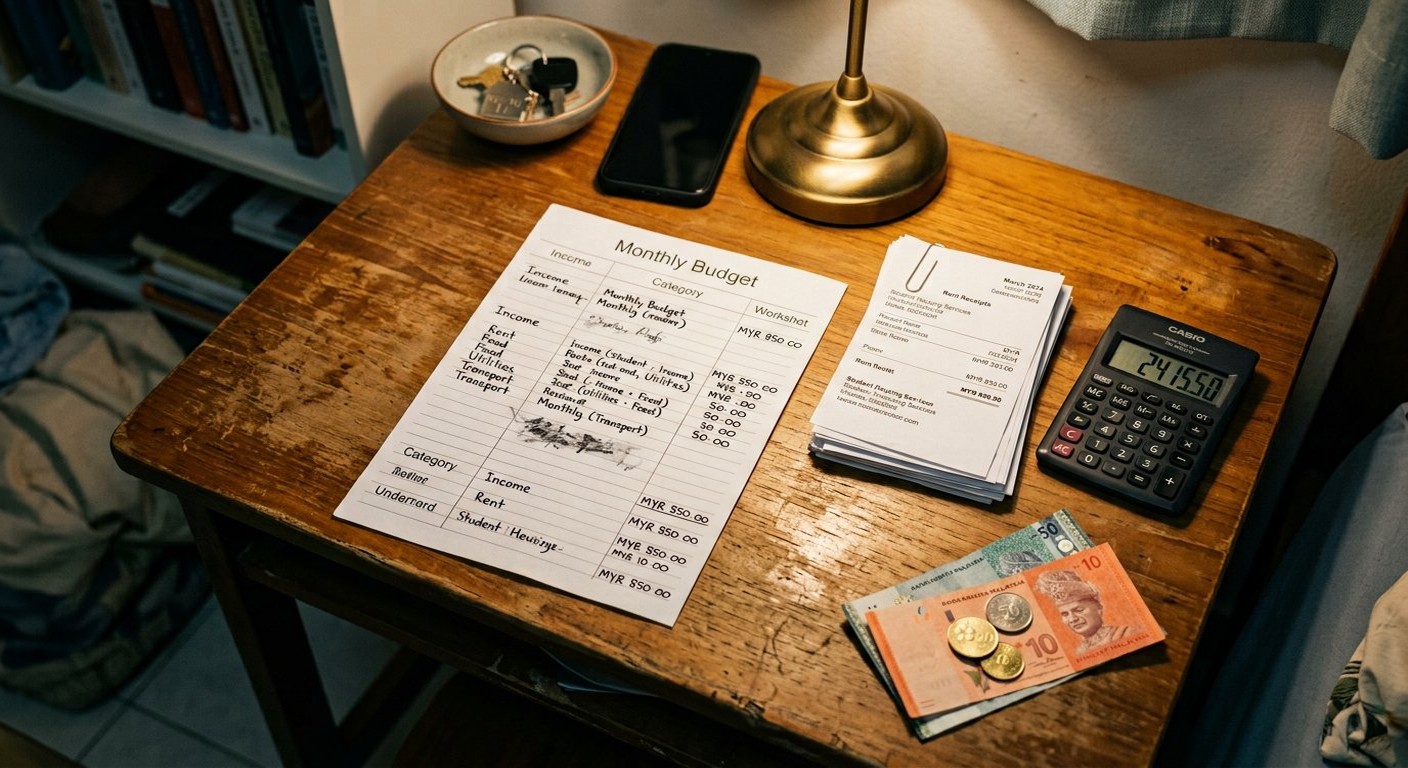
Two columns, one margin
The arrival fund is not the monthly budget — deposits itemised separately, every figure a band.
The budget worksheet is free on WhatsApp — below.
Coming with the Malaysia video series
The money, on video — in Urdu
The monthly bands walked through in ringgit, the deposit arithmetic on screen, and the fraud pattern told once so it is never lived — in Urdu. In production; until it ships, this page is the written reference.
Free worksheet · WhatsApp · no forms
Get the budget worksheet on WhatsApp
Monthly budget and arrival fund in two columns — deposits itemised, a margin built in, nothing promised.
Get the budget worksheet → +92 315 5009620 · Mon–Fri 11AM–7PM · Path Plaza (SMC) Pvt Ltd, 304 Upper Mall, LahoreWhere this sits in your journey
The budget is decided before the offer is accepted, and it is tested on arrival month, every year after.
Universities decide admissions. The Malaysian authorities decide visas. We prepare honest, complete files — that is the entire promise, and it's in writing.