Home › Study in Malaysia › The EMGS process
Path Plaza · Malaysia programme · Pillar guide
What do the EMGS percentages mean, and why is my application stuck?
Checked on 25 September 2026 · Path Plaza desk · re-checked every 30 days
The percentage is a progress bar, not a score. It shows which stage your file has reached, not how good it is, and two students can sit at the same number for very different lengths of time depending on the intake and the queue. Students who have been through it repeat the same advice: if the status is green no action is needed, and EMGS will contact you directly if a document is wrong.
01 · The stuck bar
My EMGS application has been stuck at 15% for two weeks. Is something wrong?
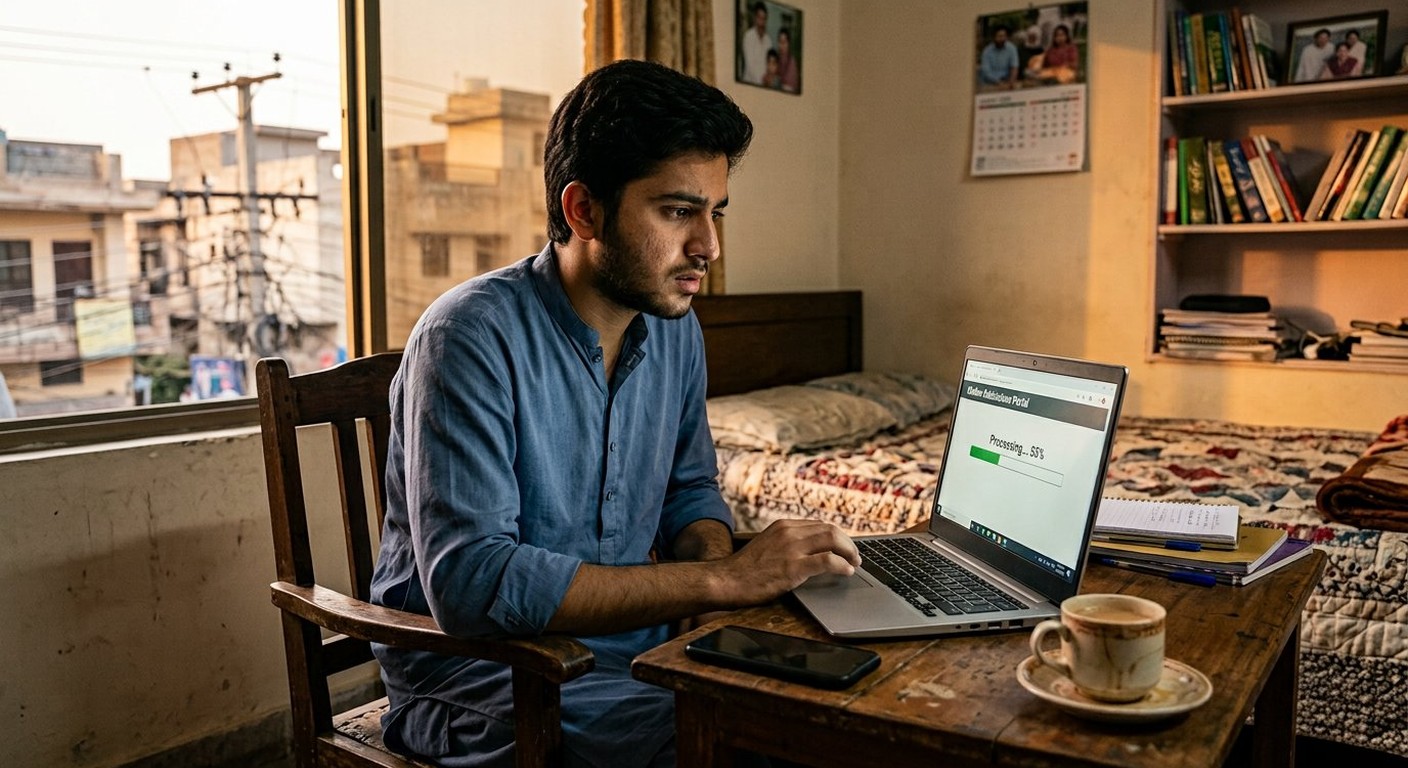
The percentage is a progress bar, not a score. Sitting at one stage is normal. What matters is whether the status has turned amber and whether EMGS has raised a document query. Green and slow is not the same as a problem.
This is the most repeated Malaysia question on the student forums, and the replies from students who got through are strikingly consistent. One student describes the bar jumping from 5% to 15% inside 24 hours and then not moving for days. Others sat at the same number for weeks and were approved. The number measures position, not health.
What actually deserves your attention is the colour, not the count. Green means the file is moving through the queue and nothing is asked of you. Amber means something needs action — usually a document query — and that query arrives by email, which is why the spam folder is part of the process. Students who missed an EMGS email under a promotions tab lost more time than any queue ever cost them.
The habit that survives this stage: check the portal once or twice a week, check email more often than that, and keep the university's international office in the loop. The application was submitted by the institution, so their view of the file is richer than the public bar. Refreshing the page does not move the file; it only spoils the sleep.
02 · The ladder
What do the EMGS percentages actually mean?
Learn the ladder once and the waiting stops being frightening. Roughly: documents submitted, EMGS vetting, immigration review, approval letter at 70%, then arrival, medical, and endorsement to finish. Do not book a flight before the approval letter is issued.
Each stretch of the bar is a named stage, and students who know the ladder report the same thing: the waiting stops being frightening. The file is created by the institution and your documents are uploaded. EMGS vets them — passport, academic documents, the photograph. The file then goes to immigration review, which is normally the longest hold and the stage where the bar seems frozen. The visa approval letter, the VAL, is the milestone students repeat to each other: it arrives around 70%, and it is the document that makes travel possible.
The last stretch surprises people every intake: the bar completes only after arrival in Malaysia. The medical screening, the endorsement of the student pass into the passport, the i-Kad — all of that is the final 30%. Watching the bar sit at 70-something from Pakistan is not a delay; that is simply where the process waits for your flight.
| Stage | Roughly on the bar | What is happening | What you control |
|---|---|---|---|
| File creation | 0–5% | The institution creates the application and uploads your documents | The quality and completeness of your scans |
| Document verification | 5–35% | Passport, academics and photograph are checked; document queries are raised here | Answering a query the same day you see it |
| Immigration review | the long middle | The file sits with immigration; the bar can hold for weeks at one number | Nothing — this is the queue, and it is not a verdict |
| Visa approval letter (VAL) | about 70% | The letter that makes travel possible is issued | Booking the flight only after this, never before |
| Arrival, medical, endorsement | to 100% | Medical screening, student pass endorsed in the passport, i-Kad issued | Doing the medical early in your window after arrival |
The percentages in that table are what students report, not official thresholds — the sequence is broadly this, and the exact number at which a stage ends varies between institutions and intakes. Treat the bar as a map, and the map as approximate.
03 · The clock
How long does the whole EMGS process actually take?
Plan for six to eight weeks and be pleased if it is quicker. The honest answer is that it varies widely and nobody can promise you a date, including your university.
Reported times vary enormously, and pretending otherwise is how families get hurt. One student logged the full run to the approval letter at just under five weeks. Others report two weeks. Others report three months. The figure students repeat to each other as an average is around six weeks for the whole process — a report, not a promise, and your intake can be heavier than the last.
What follows from that is planning discipline, not panic. Apply inside the earliest window your institution allows. Do not book a flight against a hoped-for date. Tell the university the moment a term date looks tight, because they handle this every intake. And treat anyone who sells a faster EMGS as selling something they do not have — the queue answers to the intake calendar, not to a consultant.
One more honest note: the students who suffer most are the ones who applied late and then watched the bar daily. The bar does not respond to watching. Build the plan around the long case, and anything quicker is a good week, not a correction to the plan.
04 · The deadline
My classes start next week and I still have no approval letter. What do I do?
Tell the university early and in writing. They handle this every intake and often extend registration or allow you to join online. Silence is what loses the place, not the delay.
This happens every intake, and the pattern in the threads is clear: the students who kept quiet lost things, and the students who wrote early mostly did not. The international office can extend registration. Lecturers can be emailed directly, and several students report being added to online teaching while the bar finished. Late registration exists precisely for this situation.
Write, do not call and assume. An email with the date on it is evidence; a phone call is a memory. Keep every reply. If the answer is a deferral to the next intake, that conversation is easier in week one than in week six, when the fee conversation is also on the table.
And say it to the right desk: the international office, not the admissions recruiter. The recruiter's job finished at the offer letter; the international office owns the file while it sits inside EMGS.
05 · The levers
Can I do anything to speed it up?
Chase through the university, not around it. The institution is the official channel to EMGS and immigration, so a request from them carries weight that an individual email does not.
Opinion on the forums divides, and both sides deserve reporting. Several students say plainly that nothing can be done — the queue is the queue. Others report that asking the university to send a request to immigration coincided with movement, and one credits a full recovery to it. What no thread anywhere shows is proof of causation: a file that moved may have been about to move anyway.
What you genuinely control is smaller and earlier: submit complete documents the first time, answer queries the same day, and make sure the university has everything they keep quietly waiting for. Most "stuck" files that turn out to be fixable were waiting on the applicant's side of the table, not immigration's.
What does not work, and costs money anyway: individual emails to immigration from the student, an agent claiming contacts inside the system, and any paid "expedite". If a faster process could be bought, every family in every thread would have bought it. They could not.
06 · The documents
What exactly do I need to submit for the approval letter?
The full passport scan is the one people get wrong. Cover to cover, every page, including blank ones. A partial scan is a common cause of a file being sent back.
The list students give each other is consistent: a full passport scan — cover to cover, every page including the blank ones — vaccination certificates, the health declaration form, and the fee receipts. One student's file was held simply because the university was still waiting on a single item, and the bar said nothing about it. The portal will not name the missing page; the international office can.
Two quiet rules inside that list. First, names: the passport, the certificates and the CNIC must agree, because a mismatch travels through this system into the recognition system and causes grief for years — we treat that question in full on the recognition pillar. Second, scans: clear, straight, uncropped, in the format the institution asks for. A beautiful file dying of a bad upload is the most avoidable loss in this entire process.
If you want the whole list on one page — scan standards, naming, the photograph specification, and the items to start first — the approval-letter checklist is a free one-page PDF, and it comes by WhatsApp.
Free checklist · WhatsApp · no forms
Get the approval letter checklist on WhatsApp
Get the approval letter checklist →07 · The missing certificate
EMGS wants my certificate but the result has not been issued yet.
Raise it with the university international office before submission, not after. There is usually a documented route, but it has to be agreed in advance rather than argued about mid-application.
This is a timing trap for students applying immediately after examinations, and it is reported in the threads without mercy: EMGS required the original certificate and refused to accept a statement of results. The board had not issued the certificate yet. There was nothing wrong with the student, the grades or the file — only with the calendar.
The route through it, where one exists, is documented and institutional: the international office can agree in advance how the pending result will be handled, and what will be substituted until the original exists. What there is no route through is discovering the requirement mid-application, when the file is already inside the machine and the answer is a hold.
So the rule is order of operations: ask before you pay, before you submit, and before the intake clock starts running. If the answer is "wait for the original", that is a plan. If the answer is "we accept the statement", get it in writing.
08 · The refusal
My approval letter was refused and no reason was given. What now?
Refusal without a stated reason is the normal practice, not a personal verdict. The decision rests with immigration, and neither the university nor EMGS is told why. Do not resubmit the same file; identify the weakest element and rebuild it.
A long thread on the EMGS community site records the worst version of this: a student refused at 35% with no reason given, whose institution appealed and was refused again at 60%, still with no reason. Other contributors explain what the thread slowly accepts — the decision sits with immigration alone and is not disclosed. The same student notes a friend with identical documents from the same college who was approved. Files that look the same from outside do not necessarily look the same from inside.
What follows is discipline, not despair. Ask the institution to enquire, because their channel is the only one. Do not resubmit the same file — a second refusal is worse than the first, and each application carries the history of the last. Rebuild the weakest element: the bank history that reads like it was arranged last week, the documents that answer questions nobody asked, the gap that was never explained. And refuse firmly anyone who claims to know the reason or to overturn the decision for a fee; the thread is full of that offer, and none of it worked.
The page closes where the process closes: the decision is theirs, the file is yours. Make the file so clean that nothing you control is the reason.
The map for the waiting
Green means wait, amber means act, and the ladder names every stage — keep it where the panic finds you.
The EMGS ladder is free on WhatsApp — below.
Coming with the Malaysia video series
The EMGS ladder — on video, in Urdu
The ladder drawn rung by rung, the amber-versus-green difference shown on screen, and the stuck-bar questions answered straight into the camera — in Urdu. In production; until it ships, this page is the written reference.
Free one-pager · WhatsApp · no forms
Get the EMGS ladder on WhatsApp
Every stage named, with what is happening and what to do at each — the ladder on one page, with the green-and-amber rules.
Get the EMGS ladder → +92 315 5009620 · Mon–Fri 11AM–7PM · Path Plaza (SMC) Pvt Ltd, 304 Upper Mall, LahoreWhere this sits in your journey
The EMGS process is the gate of the file's journey. It runs route → offer → EMGS → airport → the pass in your passport.